open agentic commerce: a market that kills its own merchants


Imagine a market that sells coffee beans, and you are one of its registered sellers.
You have done everything right - good beans, lower prices, better packaging, etc. You are listed, verified, and open for business.
However, when a buyer walks in and asks for coffee beans, they never see your shop.
Because in this market, buyers do not browse. Every buyer request goes through a discovery desk, and the operator sitting at that desk decides which sellers a buyer is shown.
So you walk up to him and ask why you are never on that list:
You: Why do buyers never see my shop?
Operator: Because you do not rank high enough in seller's.
You: What do I need to rank higher?
Operator: Sales volume, and a list of customers who have already bought from you.
You: But I can only get those if buyers find me and buy from me first.
Operator: Correct. And buyers only find you once you rank high enough.
Meanwhile, the largest coffee seller in the market has already taken that order.
The buyer never learned your shop existed, and the operator does not consider any of this a problem. As far as the desk is concerned, the system worked exactly as designed.
Would you keep selling in that market?
Would you tell another merchant to come and join you in it?
That is the condition of open agentic markets today.
The agentic market we are building is killing its own merchants
So I spent the last few months working out what that layer actually rewards. I read their docs, went through the open-source code, and pulled the full catalog — 2,252 merchants across 13 categories — to see what the ranking really measures.
This article explores what I found, and my concerns with agentic commerce.
first, what is a MARKET ?
A typical definition of a market is a system where buyers and sellers come together to exchange goods, services or information.
A true market, however, has one more core ingredient: competition among sellers. It is the foundational pillar of how a market operates.
A healthy market allows businesses or merchants to actively participate and compete against others to win over customers.
In a well-functioning market, there exists:
- a level playing field that encourages the entry of new sellers in any category to compete on price, features, services, etc,
- a real choice of buyer to choose from merchants that fits best,
- a continual competition among sellers to improve product and services quality, drive prices lower, improve overall efficiency so they could win the buyers.
Economists have a word for this and I want you to hold onto it: contestability. A market is contestable when today's market leader can be challenged tomorrow.
A market's job is not to produce & support winners, monopolists or leaders. It is to always let the buyers decide who they are.
I want you to carry these fundamental first-principles of a market through the rest of this piece - we will use it to evaluate the open agentic market that exists today.
Now, the open agentic market of today
Now, in an open agentic x402 market:
- Agents are buyers
- Merchants/Sellers are mere API endpoints ( with 402 attached to it )
- x402 protocol defines the mechanics to request and verify the payment
- facilitators ( e.g. Coinbase ) sit in between to complete the transaction from buyers to sellers.
Here is a visual representation of a typical x402 transaction:
- User asks for a particular service
- User’s Agent queries merchant’s API endpoint to get the service
- Merchant endpoint returns a 402 code + payment instructions
- User’s Agent signs the payment
- Once the payment settles, the user’s agent gets the service.
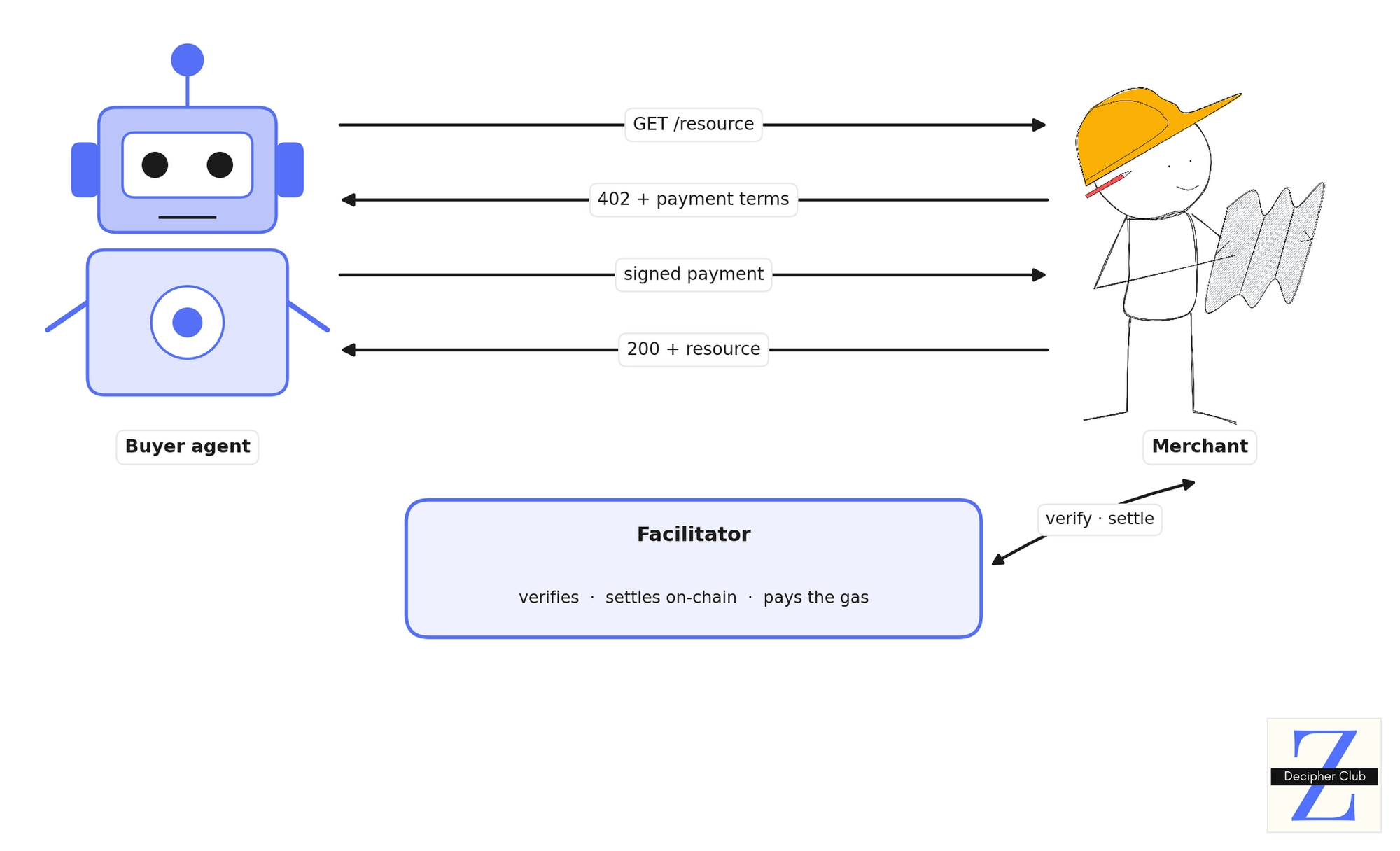
We already have a well-defined structure for:
- Buyer Agent to purchase services from 402 API Endpoints
- Seller/Merchants to register their API endpoint with 402 and start selling
- x402 protocol and facilitators that verify and settle the payment on chain.
However, this happy-flow works when buyers have selected the merchant they want to buy from.
So the question is:
How exactly does a buyer discover and select a merchant?
Buyers in open agentic markets are very unique.
This is the only market where the buyers are machines that cannot be lured with advertisements, marketing campaigns, or brands. They have very specific requirements and a budget, and they purchase exactly what is needed in seconds. This is a market where it's extremely hard to sell to this new type of buyer.
This is where discovery Indexes come in.
A discovery index is a searchable catalog of x402 endpoints ( aka merchants/sellers ) — this is the most common way buyer agents discover merchants for their needs.
The top 3 most popular discovery indexes are:
- CDP Bazaar — Coinbase. Lists what settles through Coinbase's facilitator.
- x402scan — Merit Systems, an explorer and index over on-chain x402 activity.
- AgentCash — Merit Systems. Catalog plus agent-facing tooling.
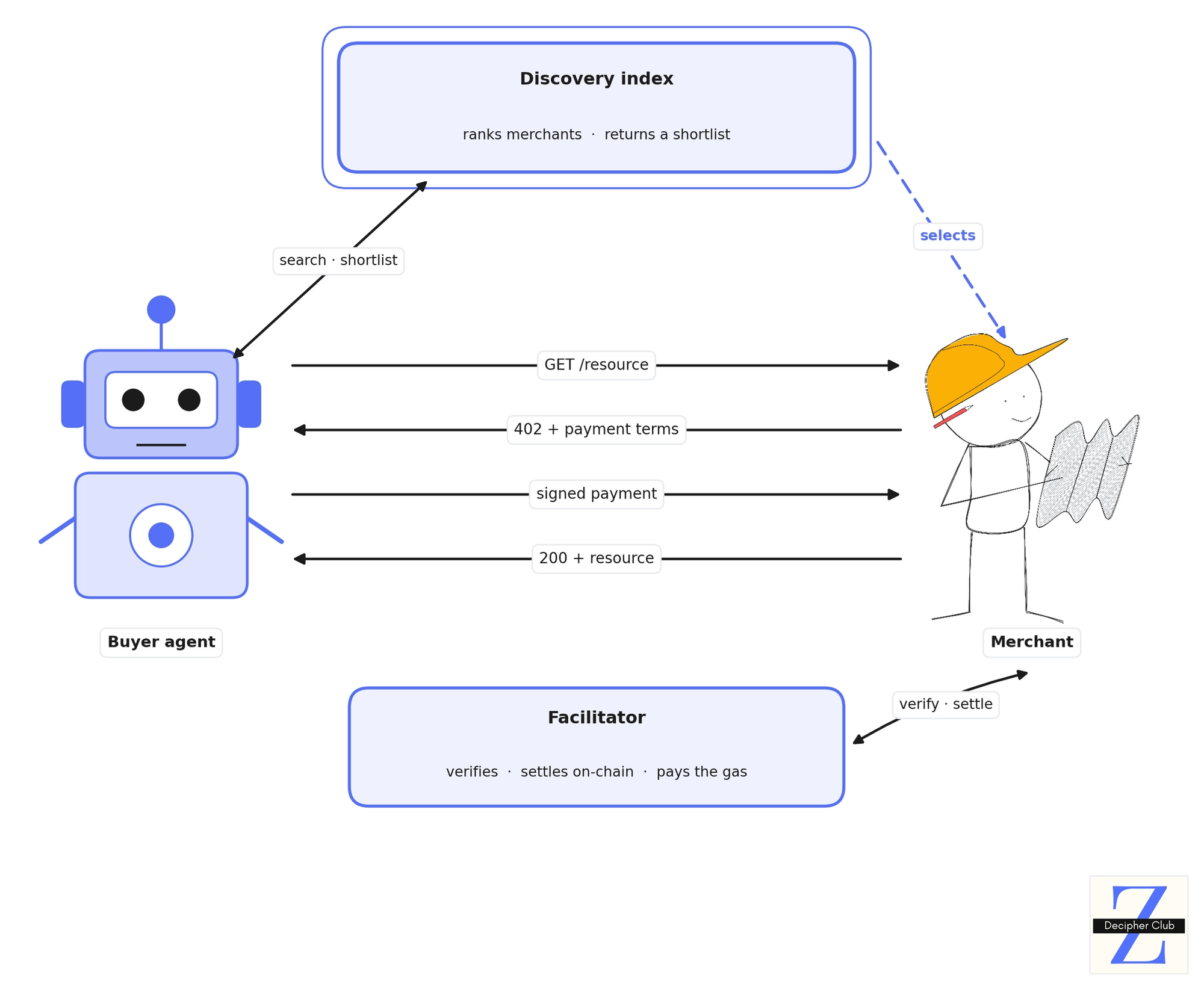
Discovery indexes sit between the agents and the merchants. And as you can already guess, their position makes them an imperative player in this market.
To understand this, let’s get a layman understanding of how a typical discovery index works.
- When Merchants Register:
- A merchant registers its endpoints on its preferred discovery index.
- The index calls the endpoint like a buyer would and reads price, token, chain and wallet address straight out of the 402 response, to confirm its validity.
- It files the merchant into a category — web scraping, market data, SEC filings, etc.
- It scores the merchant by running its own formula over that listing and turning it into a single number — the black box formulae, because most indexes do not disclose it.
- When Agent Purchases:
- An agent searches - "Something that scrapes blockchain whitepapers, under a cent."
- The index returns a ranked short list of merchants as per its ranking black box formulae. A handful of merchants, in an order the index chose.
- The agent picks one and pays it directly.
Discovery indexes were never part of the core x402 protocol. However, their position in the stack makes them a critical player in this market.
so, what’s wrong with Open Agentic Markets?
Discovery indexes play a crucial role in ranking merchants that are seen by agents. The merchants on that ranked list are the ones that get to sell. A discovery index eventually decides - “Which merchant can an agent buy from?”
The core problem is not that discovery indexes rank merchants. It is what they rank them on.
So the question worth asking is which features of a merchant an index actually reads when it decides what a buyer gets shown — and which features it ignores completely.
None of the popular discovery indexes openly publish their ranking formula. It is a black box by design.
However, their docs and their open-source code do give away what goes into that black box. So in my research, I analyzed the docs and publicly-accessible code of the top 3 discovery indexes and pulled out every signal they admit to using when they rank a merchant.
Details of this research can also be found HERE
1. CDP Bazaar ( Coinbase )
Bazaar ranks in two steps.
- First it matches your listing against the agent's query.
- Then it orders the matches using what Coinbase calls a quality score.
| Metric | What it means | Where it lives |
|---|---|---|
| Query relevance | How well your listing text matches what the agent asked for | searchMethod ( hybrid / vector / text ) |
| Transaction volume | Number of successful payments your endpoint settled in the last 30 days | quality.l30DaysTotalCalls |
| Buyer reach | Number of distinct wallets that paid you in the last 30 days | quality.l30DaysUniquePayers |
| Recency | When your endpoint was last called. Go silent for 30 days and you are removed from results | quality.lastCalledAt |
| Metadata quality | How complete your listing is. Generic or placeholder descriptions score 0 | description, serviceName, tags, extensions.bazaar |
| Hosting | Tunnel hosts like ngrok are de-weighted. One domain cannot flood the results | resource URL host |
| Curated tier | Coinbase-approved partners rank above everyone else. There is no self-serve way in | curated: true |
Note: the weights are not published, and Coinbase says they may change as the index is tuned. Scores recompute every 6 hours. And the search endpoint returns a maximum of 20 results — there is no page two.
2. x402scan ( Merit Systems )
x402scan is the simplest of the three.
The list an agent actually receives is sorted by two counters.
| Metric | What it means | Where it lives |
|---|---|---|
| Tool call count | How many times agents have called your endpoint through x402scan | toolCalls._count ( sorted descending ) |
| Tag count | How many tags your listing carries. Used as the tiebreaker | tags._count ( sorted descending ) |
| Query match | A plain substring match on your URL, wallet address, title and description | contains on resource, payTo, metadata.title, metadata.description |
| Success rate and latency | Measured only for calls that went through x402scan's own proxy — not the whole network | success_rate, avg_duration |
| Liveness | A cron job pings your endpoint expecting a valid 402. Fail it and your cached listing data is deleted | /api/resources/ping |
Note: x402scan does have a richer internal pipeline ( LLM keyword expansion plus a reranker ), but it sits behind an API key and is marked internal-only. Public agents get the simple sort.
3. AgentCash ( Merit Systems )
AgentCash is the most transparent about what it reads.
The signals are right there in the API response. The final blend of those signals, however, is not public.
| Metric | What it means | Where it lives |
|---|---|---|
| Semantic similarity | How close your listing is to the query, measured by embedding | vectorSimilarity.score, vectorSimilarity.rank |
| Transaction count | Payments settled on your endpoint | resourceUsage.transactionCount |
| Unique wallets and users | Distinct wallets and users that have paid you | resourceUsage.uniqueWalletCount, resourceUsage.uniqueUserCount |
| Volume in USD | Total dollar value settled on your endpoint | resourceUsage.volumeUsd |
| Trusted user ratio | Share of a curated set of 3,409 "trusted" wallets that have used you. The list and the math behind it are not public | resourceUsage.trustedUserUsageRatio |
| Last seen | When your endpoint was last used | resourceUsage.lastSeenAt |
| Origin usage | All of the above, added up across every endpoint on your domain | originUsage.* |
Note: AgentCash also ships a hard-coded list of "registered origins" that its agent tooling checks before running any search at all. If the task maps to one of those, search is skipped.
so, what’s wrong?
Every index values a merchant ( and ranks them ) on the basis of:
- how much merchant has sold — transaction volume, tool calls, volume in USD
- how many unique people have already bought from merchant — unique payers, unique wallets, trusted users
- How recently someone bought from the merchant — last called, last seen
Every signal that decides your rank is a record of sales that have already happened.
Combine what all three indexes admit to, and the shape of the ranking looks roughly like this:
The black box ranking formulae (derived)
score = 0.40 · volume + 0.25 · buyerDiversity + 0.15 · listingQuality + 0.15 · recency + 0.05 · reliability
these ranking weights are my own derivation from the disclosed signals of popular indexes, not a strict formula any of them has published.
Now, the core issue here is:
- Two-thirds of a merchant's rank relies on its sales history.
- The remaining one-third is the only part a merchant actually controls — how complete its listing is, and how fresh it is.
However, if a merchant’s discoverability and rank depend on its sales and user count, only the existing incumbents of any category are favored.
A new merchant — or a small existing one — has none of it. Not because its product is worse. Simply because no agent has been shown it yet.
Discovery indexes rank merchants on metrics that only the existing big players have. A new merchant, no matter how good, cheap or reliable it is, starts with zero on every metric that matters.
And that is exactly what is wrong with this market.
Go back to the definition of a market from the first section.
A market needs a level playing field, real choice for the buyer, and constant competition among sellers.
Open agentic markets, as they stand today, have none of the three:
- No level playing field — a new merchant enters with zero on 65% of the score, and cannot earn that 65% without first being ranked.
- No real choice for the buyer — the agent sees 20 results, ordered by who sold the most before. It never sees the rest.
- No competition on price, quality or service — none of these are ranking signals.
"…but every market has only a few top winners, right?"
that’s a fair question.
The top 10 apps get most of the downloads. The top 10 books get most of the sales. A handful of restaurants in any city get most of the bookings. Concentration is normal in any market.
Fair point. And my argument is not against winners.
My argument is against the fact that buyers are not the ones deciding the winners in an open agentic market.
And this is exactly where the second problem with open agentic markets shows up.
The 2nd problem: the opportunity to compete has been removed
The problem with open agentic markets is not that whales or giants exist in every category. Every market has them.
The problem is that the opportunity for a new player to challenge the incumbents has been taken out of the equation entirely.
Think about any traditional market.
It is hard for any new seller to climb up and win customers, but they always have tools to move up and sell more — paid ads, influencer marketing, branding and customer outreach, collaborations, undercutting on price.
However, an agentic market doesn’t provide any such tools to its new or smaller merchants.
Here is what exists today.
Coinbase's own seller guidance says a good natural-language description ranks higher than a bare endpoint name.
However, that doesn’t necessarily work either. I tested that against the catalog.
Documentation quality explains at most 13.4% of the gap between the top and the bottom of a category. In one category — Finance & Markets — it actually runs negative. Better-documented merchants sit lower, not higher.
Here is one real example. Every number below comes from the catalog snapshot in the open audit repo, pulled on 9 September 2026:
- Honeyguide Verified Router has the most complete listing of any merchant in Crypto & DeFi — a 473-character description, five tags, a full input schema and an output example.
- On my listing-quality score it is the highest of all 497 merchants in the category.
- In my reference ranking of that category it sits 250th of 497.
- It settled 3 transactions in thirty days, from a single buyer, for a total of two cents.
Remember from the earlier section — buyers in this market are machines. They cannot be lured by ads, brands or marketing campaigns. The only thing that reaches a machine buyer is the index.
So every tool a seller would normally use to climb collapses into one: the ranking. And the ranking reads sales history. Which a new merchant does not have. Which it cannot get without first being ranked.
In a traditional market, the ladder is hard to climb. In an open agentic market, there is no ladder.
The problem is not that this market has winners. The problem is that it has already decided who they are — and left no way for anyone else to try.
my concerns for open agentic market
I am an optimist when it comes to x402 and agentic commerce.
What worries me is not that agentic markets have volume concentrated in the hands of a few. Every market does. What worries me is what happens to a market that cannot refresh its own supply side in the long run.
Some obvious answers are:
- The market stops improving.
- Competition among sellers is what drives prices down and quality up. A seller improves because another seller might take its customers away.
- Remove that threat and you remove the reason. An incumbent that cannot be challenged has no reason to lower its price, improve its uptime or build a better product. It only has to keep being the incumbent.
- The buyer loses too — not just the seller.
- An agent's entire job is to find the best service for its user at the best price.
- What it actually receives is a list of twenty, ordered by who sold the most last month. Not who is cheapest or most reliable or best at the task.
The x402 market is still at a nascent stage. The four largest categories on x402 hold 839 merchants between them. Over thirty days, they settled under $39,000 in total - hence a very tiny market.
And that’s one reason why the ranking order doesn’t seem like a bigger problem yet.
Discovery ranking is not a feature that gets revisited once real volume arrives. It becomes plumbing. By the time this market is big enough for people to argue about how merchants get ranked, the ranking will already be load-bearing.
There is one fact worth holding onto, and I am stating it as a fact, not as a fix.
The concentration in x402 today rests on the discovery ranking and nothing else. No merchant in these categories has a network effect. None has a cost advantage. None has a moat that would survive the ranking changing.
Which means this is not a market condition. It is a design decision — and design decisions get made again.
x402 solved the hard part. Machines can now pay each other, permissionlessly, with no human in the loop. That is genuinely new, and it works.
But payments were never the whole market. A market also needs a way in — and right now, the layer that decides who gets seen is quietly answering that question the same way, every single time.
the problem is not that this market has winners.
that problem is that the winning actors of the agentic markets are not decided by the buyers of this market.
I am worried open agentic markets might actually kill their merchants.
Every number in this piece, and the code behind it, is in the open audit repo. A longer report is on the way.
Cheers Decipherers
Resources
- x402 Unfairness Audit — code, catalog snapshot and reference ranker
- CDP Bazaar documentation — discovery search, quality signals, curation and seller guidance
- x402scan — Merit Systems source
- AgentCash — catalog resource pipeline
- CDP Bazaar — documentation. The Bazaar discovery docs, plus the
extensions/bazaar.mdextension spec in the x402 specification repo.