Why are x402 merchant poor ?


x402 merchants in open agentic markets are very poor.
And they might remain poor with the way the current mechanics work.
here are some stats from the recent x402 market analysis i ran:
- 2,252 merchants had a live listing that an agent could find and pay. Between them, they settled $76,279.84 over thirty days.
- The median merchant earned six cents. Not six cents a call — six cents in total, for the entire month.
- Four out of every five merchants earned less than one dollar in those thirty days. 59 of the 2,252 — under 3% — cleared $100.
- The median merchant had two distinct buyers in thirty days, and 724 of them were paid by exactly one wallet for the whole month.
Here is the part that should bother you.
These are not abandoned listings. They are live services that respond, get paid and settle. They just never get asked.
Most merchants are never seen by the buyer agent - even if they have better products to sell.
Let me explain why..
First, how much does an x402 merchant actually earn ?
From my analysis, those 2,252 merchants sit across 13 categories, and their combined settled revenue over thirty days was $76,279.84 — roughly the price of one mid-sized engineering salary, split across two thousand businesses. - as long as the engineer has a job, lol.
Here is how that splits by category, for the four largest analysed categories plus the catch-all bucket.
| Category | Merchants | 30-day revenue | Median merchant | Share under $1 | Merchants over $100 |
|---|---|---|---|---|---|
| Crypto & DeFi | 497 | $34,673.65 | $0.10 | 77% | 8 |
| Other | 1,256 | $30,139.93 | $0.05 | 83% | 42 |
| Data & Enrichment | 91 | $2,166.29 | $0.14 | 73% | 3 |
| AI & Agents | 194 | $1,014.46 | $0.02 | 83% | 2 |
| Finance & Markets | 57 | $880.70 | $0.26 | 74% | 1 |
Note how the median column barely changes.
A merchant in the largest category by revenue earns ten cents. A merchant in the smallest earns twenty-six. Whatever is happening here, it is not a function of which category you picked.
And the top of the distribution is thinner than the totals suggest:
- One merchant holds 38% of the entire catalog's revenue. *Bitrefill settled $29,000.29 over thirty days, from 192 transactions and 88 distinct buyers.*
- The top three merchants hold 59.5% between them. The top ten hold 69.2%. The top 1% — 22 merchants out of 2,252 — hold 78.6%.
- The third-largest earner made $6,417.76 from two transactions, paid by one wallet. That is 8.4% of everything the catalog earned, from a single buyer.
TLDR; The typical x402 merchant is not underpaid. It is unpaid.
Note: these are reported settlement figures - and wash trading and self-payment could be included. I am not filtering them out, because the ranking that decides which merchants agents see does not filter them out either. Every index reads this number as it stands.
so, why are x402 merchants poor ?
There are four answers to this.
1. market is genuinely small
let's put the obvious one first - x402 markets are at nascent stages.
- The real volume is tiny. Visa, working with Artemis put x402's adjusted lifetime volume at $15.0 million across 109.6 million transactions as of April 2026, after excluding wash and test activity.
- A large share of the reported activity is not real. Artemis reported in January 2026 that 86% of Solana's all-time x402 activity was gamed.
- A population-scale study of Base agrees. A July 2026 measurement of 136,708,672 settlements found 21.20% outright fictitious and 63.78% internal to linked wallet clusters. Of $44.1 million in nominal volume, only $187,861.35 was demonstrably authentic.
So yes — the market is small, and a good part of the size it reports is manufactured. I am not going to pretend otherwise.
However, size explains the total. It does not explain the distribution.
A $76,000 market spread evenly across 2,252 merchants would pay each of them about $34 a month. That is a small market. What we actually have is one merchant on $29,000 and 1,814 merchants under a dollar, and no amount of "it is early" produces that shape on its own.
my concern is - A small market makes everyone a little poor. It does not make three merchants rich and eighteen hundred merchants worthless.
2. price of everything is a rounding error
The second reason, I believe, is arithmetic. sort of connected to the first reason.
x402 was designed for micropayments, and the catalog is priced accordingly. Across the 29,658 listed resources with a price attached:
- The median listed price is $0.01, and one cent is also the single most common price in the catalog.
- Nearly 59% of all listings are priced at one cent or below. A quarter sit at $0.003 or lower.
- Crypto & DeFi, the largest category, has a median listed price of $0.006 and a modal price of a tenth of a cent.
Now run the arithmetic a merchant has to run.
At the median price of one cent, a merchant needs 10,000 successful agent calls a month to earn $100. At the $0.002 that a lot of the scraping and data endpoints charge, it needs 50,000.
Here is one real example of what that means. Minifetch Technical SEO API is a well-documented listing. It was called 80 times by 22 different buyers in thirty days.
how much it earned? - 36 cents.
That is a merchant ranking near the top of its category, finding real buyers. Eighty successful sales, twenty-two customers, thirty-six cents.
So price is real. However, it only explains why a merchant that sells earns so little. It does not explain why most merchants sell nothing at all.
3. buyers that do exist, never come back
This is the one I did not expect to find.
This is also a counter for those who believe - "the market only needs more agents"
Every figure in this section comes from the catalog snapshot in the audit repo. - feel free to check.
- The median merchant had two distinct buyers in thirty days.
- 724 merchants — 32% of the whole catalog — were paid by exactly one wallet for the entire month.
- Of the 2,092 merchants that made any sale at all, 856 were never bought from twice by the same wallet. Across every merchant that sells, the median is 1.38 transactions per buyer.
For the typical merchant, a buyer arrives, pays once, and does not come back.
A buyer arrives, pays once, and does not come back. There is no repeat demand in this market, which means there is no such thing as a customer base here — only a sequence of one-off calls that happen to land on you.
On the other hand, the supply keeps arriving anyway. 643 of the 2,252 merchants — 29% of the catalog — first appeared in the index inside the same thirty days I measured. Demand is one call deep, and new sellers are still queueing up behind it.
4. most merchants are never seen by buyers/agents
This is the critical reason - that concerns me the most.
Most x402 merchants never get an order - they are never seen by agents.
And this is the reason that gets worse rather than better.
1. registration of a merchant is the easy part, but then
2. To sell, a merchant has to be seen to agents
3. To be discoverable, a merchant has to sit at the top of a ranked list.
4. How is ranking decided ? - most indexes value volume, buyer diversity, and similar metrics to decide rank of a merchant.Those are the heaviest signals in every index that publishes what it reads.
5. These are metrics most existing or new merchants don't have ( despite better products, and listings )
6. Only early incumbent merchants in a category with enough volume, buyers already - have those numbers. Most new or small merchants start at zero on all of them.
7. hence, the ranked list shows the merchants that already sold, to every agent, most of the times.
The market is not too small to pay everyone.
It is arranged so that whatever it does pay goes to the same few.
But let’s understand why.
Why merchants do not get orders
Merchants do not get orders because of the way discovery indexes are built. Here is how the three most-used ones — **CDP Bazaar, x402scan, AgentCash** — admit a merchant, rank it, and hand it to an agent that wants to buy:
- To sell, a merchant has to be seen/discoverable to agents
- To be discoverable, a merchant has to sit at the top of a ranked list. The search endpoint agents query returns at most ~20 results, and there is no page two.
- The ranking reads a 30-day transaction volume and distinct buyers. Those are the heaviest signals in every index that publishes what it reads.
- Only incumbent merchants that have already sold have those numbers. Most new or small merchants start at zero on all of them.
- So the list shows the merchants that already sold, to every agent, every time.
If I can represent all of that in a picture, here is what a x402 merchant’s dilemma looks like
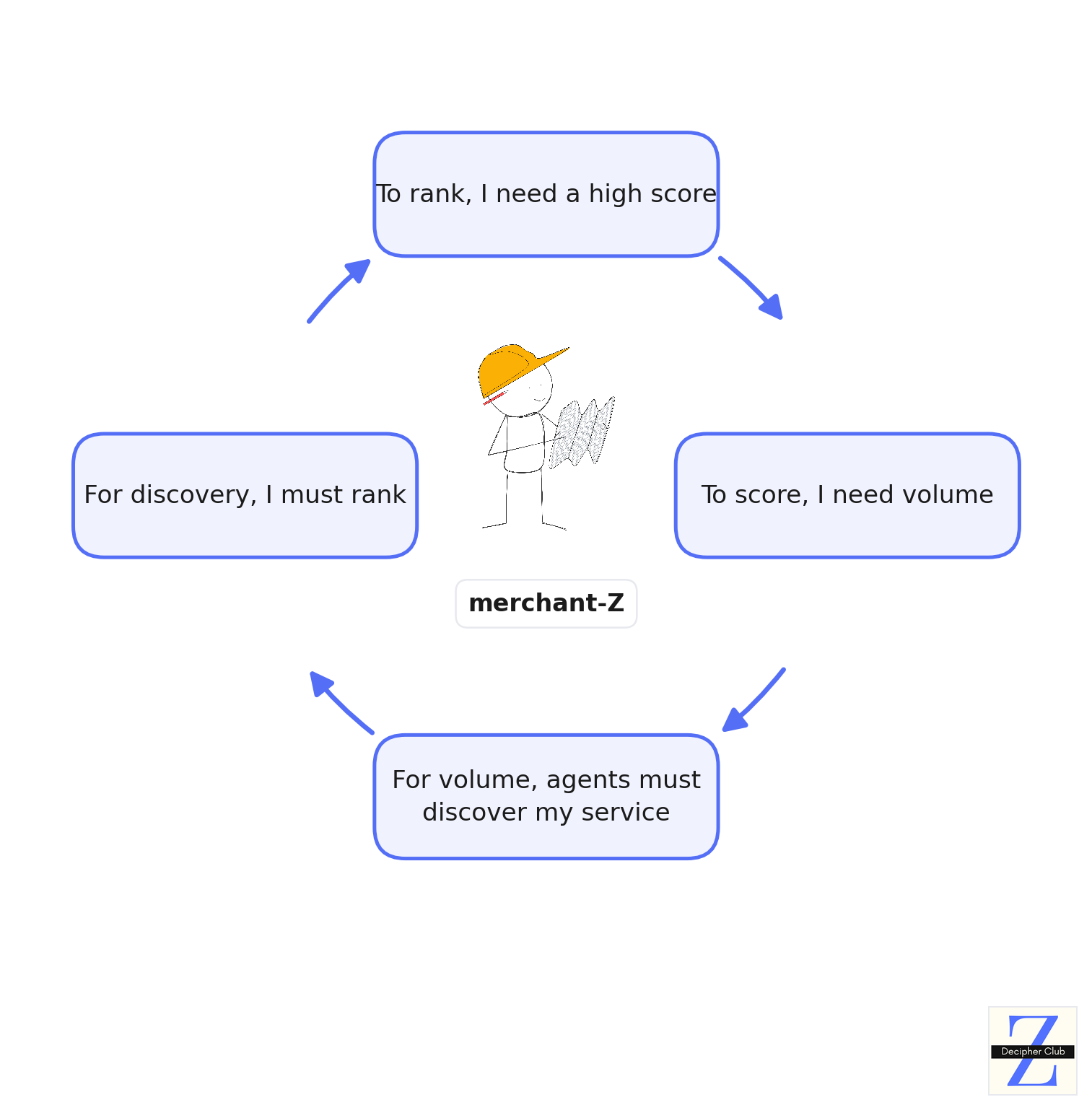
So, why will they remain poor ?
Everything so far describes a bad month. What makes it permanent is that reasons two and four lock into each other. I have been calling this the volume trap, and it has two jaws.
- 1st — prices are micro, so earning anything at all requires volume. At a cent a call, revenue only exists in the thousands of calls.
- 2nd — rank requires volume, and rank is the only source of volume. The thousands of calls only arrive if an agent is shown you, and you are only shown if you already had the calls.
A merchant needs volume to earn and volume to be seen, and there is no entry point to either.
Now, the obvious response is that this is what being early looks like, and that patience fixes it. It does not, and this is the part I find hardest to argue past.
- Waiting actively hurts you. The one input a merchant fully controls is listing freshness, and freshness decays to zero over ninety days on its own. A merchant that lists and waits ranks worse in month three than in month one.
- But, better documentation gets you admitted, not ranked. Completeness of your listing is a small term in the score and a prerequisite for being catalogued. It is not a lever.
- Undercutting buys you nothing. I checked this one carefully, because it is the move every new seller reaches for first. No index ranks on price. CDP Bazaar accepts a maxUsdPrice filter, so a cheaper listing can qualify for a budget-capped query — but inside the results it returns, price moves you nowhere. You give up revenue per call and gain no rank.
A merchant in this market cannot earn its way out, wait its way out, or build its way out.
The merchants at the top of x402 categories are not there because they won. They are there because they were there first, and the ranking has no mechanism for changing its mind.
Relevant Readings
- x402 Unfairness Audit — catalog snapshot, revenue and pricing data
- Visa, with Artemis — agentic payments from the ground up — adjusted lifetime volume, April 2026 data
- Artemis Weekly, January 2026 — 86% of Solana x402 activity gamed
- x402 is more than Agent Payments
- How Agentic Is Agentic Commerce? A Population-Scale Measurement of x402 Adoption and Authenticity — 136.7M settlements on Base, authenticity breakdown
- TRM Labs — Who's actually paying? Measuring AI agent payments onchain — September 2026 screen of settled volume
- CDP Bazaar documentation — ranking signals, search result limits