Trustless Agents Plus

ERC-8004 agents are fragmented.
Ethereum solved 3 imperatives for on-chain agents:
- a reliable way to prove identity,
- a system to accumulate reputation from feedback,
- and a standard for cryptographic validation of on-chain work.
For agents on a single chain, this works.
But not for agents that co-exist on multiple different chains.
TAP fixes this.
If you have agents running on-chain,
YOU NEED TAP.
What is TAP ?
TAP solves a simple problem: AI agents registered on multiple blockchains have no way to prove they're the same agent or carry their reputation across chains.
TAP adds two contracts on top of ERC-8004 — without changing any existing per-chain registries.
- TAPRegistry gives each agent one canonical identity. Per-chain ERC-8004 registrations link to it via cryptographic signature proofs. Identity tokens are soulbound and non-transferable.
- TAPReputationRegistry collects per-chain reputation data, normalizes it, and computes a single 0–10,000 basis point trust score factoring quality, volume, chain diversity, and slashing history.
Here's how it works:
- an agent registers once with TAP and receives a unique
agentId— a permanent, soulbound identifier derived from its Universal Executor Account address on Push Chain. - It then submits cryptographic binding proofs (EIP-712 signatures) that link its per-chain addresses to that single
agentId. - From that point forward, any action the agent takes on any bound chain counts toward its unified reputation score.
- That score — tracked by the TAPReputationRegistry — runs from 0 to 10,000 basis points and is composed of four factors: a base anchor score, a volume multiplier for activity, a diversity bonus for operating across multiple chains, and a slash penalty for verified violations.
The result: a trust layer that travels with the agent. Not locked to one chain. Not fragmented. One identity, everywhere.
Try TAP Now
Quick start with create-8004-tap-agent in minutes.
Documentation
- TAPRegistry — agent registration, soulbound identity, and binding proof submission
- TAPReputationRegistry — reputation scoring, slashing, and cross-chain aggregation
- Push Chain Docs — the underlying chain TAP is deployed on
Deployed Contracts
| Contract | Proxy Address | Explorer |
|---|---|---|
| TAPRegistry | 0xa2B09263a7a41567D5F53b7d9F7CA1c6cc046CE2 |
View on Explorer |
| TAPReputationRegistry | 0x591A56D98A14e8A88722F794981F00CabB328a91 |
View on Explorer |
TAP - Deep Dives
 Zaryab Afser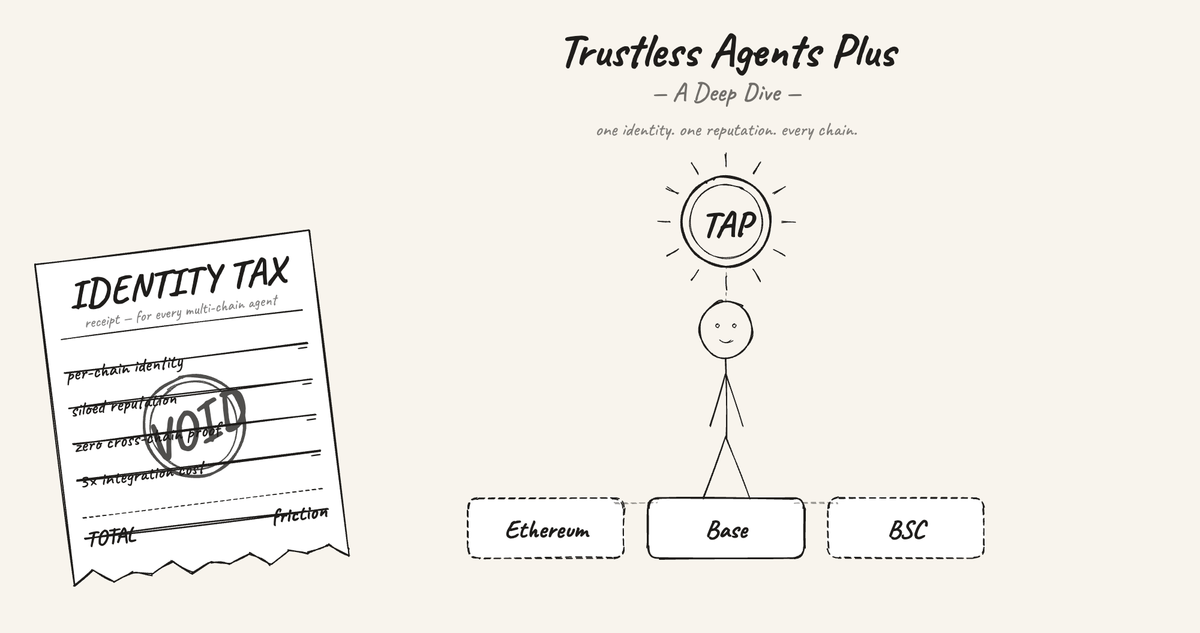
 Zaryab Afser
 zaryab2000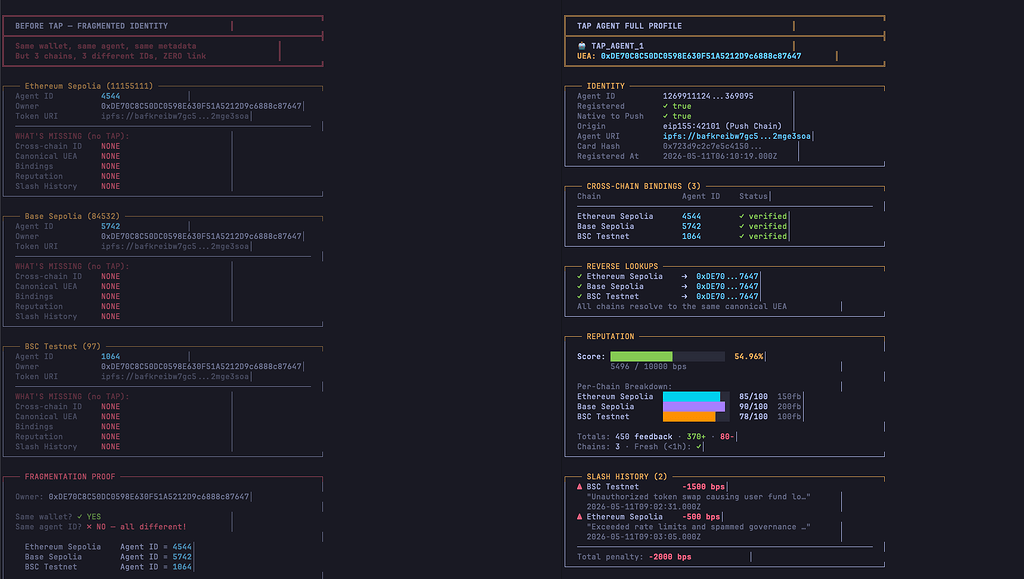

TAP Proposal On Ethereum Magicians
Join Official Forum DiscussionsTAP Live Roadmap
v1 — Deployed ✅
The first version of TAP is live on Push Chain (Donut testnet).
- TAPRegistry — soulbound agent identity via UEA address.
agentId = uint256(uint160(ueaAddress)) % 10_000_000. One canonical ID per agent, non-transferable. - TAPReputationRegistry — aggregated 0–10,000 bps reputation score. Formula:
baseScore × volumeMultiplier + diversityBonus − slashPenalty. - EIP-712 binding proofs — cryptographic link between per-chain agent addresses and the canonical
agentId. CoverschainNamespace,chainId,registryAddress,boundAgentId,nonce,deadline. - CAIP-2 namespace-agnostic storage — bindings store chain identities as namespace strings, not hardcoded chain IDs. Ready for non-EVM chains at the storage layer.
🔜 Decentralised Reputation Reporter
Currently, reputation data is written to TAPReputationRegistry by a trusted reporter. The next milestone replaces this with a decentralised network of reporters that independently observe agent activity across chains and submit signed attestations.
No single party controls what gets scored. Reporters stake to participate and get slashed for false attestations. The result: a reputation layer that's as trustless as the registry it reports into.
🔜 Agent Registration UI
A dedicated web interface that lets existing agents — or the developers running them — register with TAP without touching contract ABIs directly.
Connect your wallet, submit your UEA address, sign the binding proofs for each chain you operate on, and your agent is in the registry. Built for the developer who wants the identity layer without the Foundry scripts.
🔜 Cross-Chain Reputation Reads (TAP Score Oracle)
Any contract on any supported chain should be able to call TAPScoreOracle.getScore(agentId) and get back the aggregated reputation score — without bridging assets or running a full node.
Implementation: a lightweight oracle that caches scores cross-chain, plus a TAPGate modifier contract that lets any protocol gate function calls on TAP score thresholds. Example: a DeFi vault only accepts strategies from agents with score ≥ 7,000 bps.
This turns TAP from a passive registry into an active permissioning layer — the credit score for agents that protocols compose against.
🔜 Agent-to-Agent Trust Graphs
Agents that vouch for or delegate to other agents, creating a directed trust graph on top of TAP identities.
Example: a "portfolio manager" agent delegates execution to specialised "swap" and "bridge" agents, staking its own reputation on their behaviour. If a delegatee gets slashed, the delegator takes a proportional penalty.
This enables composable agent hierarchies with aligned incentives — and makes TAP the coordination layer for multi-agent systems, not just a single-agent registry.
🔜 Non-EVM Chain Bindings (Solana, Cosmos, Move)
Extend BindProofType beyond ECDSA/ERC-1271 to support Ed25519 (Solana), Secp256k1 with alternative address derivation (Cosmos), and Move-native signatures.
The storage layer is already namespace-agnostic — CAIP-2 strings mean the registry doesn't care what chain the identity lives on. The gap is purely in signature verification. Once this ships, TAP becomes a truly universal agent registry: not just multi-EVM, but multi-ecosystem.
Further Reading
Everything you need to understand the problem space TAP operates in:
- ERC-8004 specification — the on-chain agent identity standard TAP extends
- 8004scan.io — live agent registry explorer for ERC-8004
- Ethereum Magicians — ERC-8004 Discussion — original ERC-8004 forum thread
- ENS: Identity Problem in Agentic Commerce — ENS's take on agent identity and ERC-8004
- a16z: AI Needs Crypto — Especially Now — the macro case for blockchain-native AI infrastructure
- CSA/Strata: AI Agent Identity Crisis Survey — research on the governance gap in agentic identity
- BNB Chain: Making Agent Identity Practical with ERC-8004 — ERC-8004 adoption on BNB Chain
Join the community 👉 Decipher Club Telegram