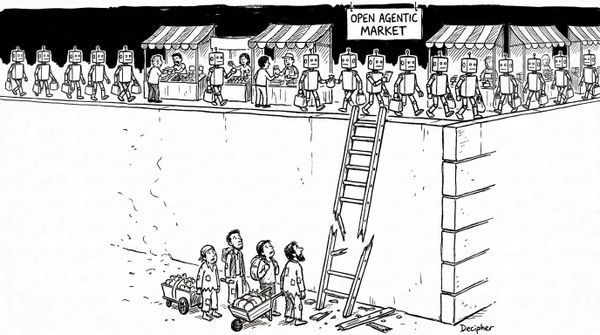
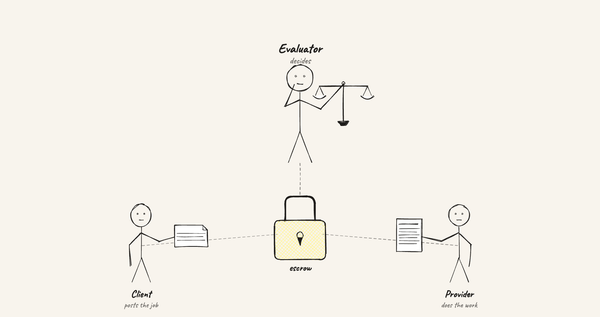
Trustless Agents Plus - A Deep Dive

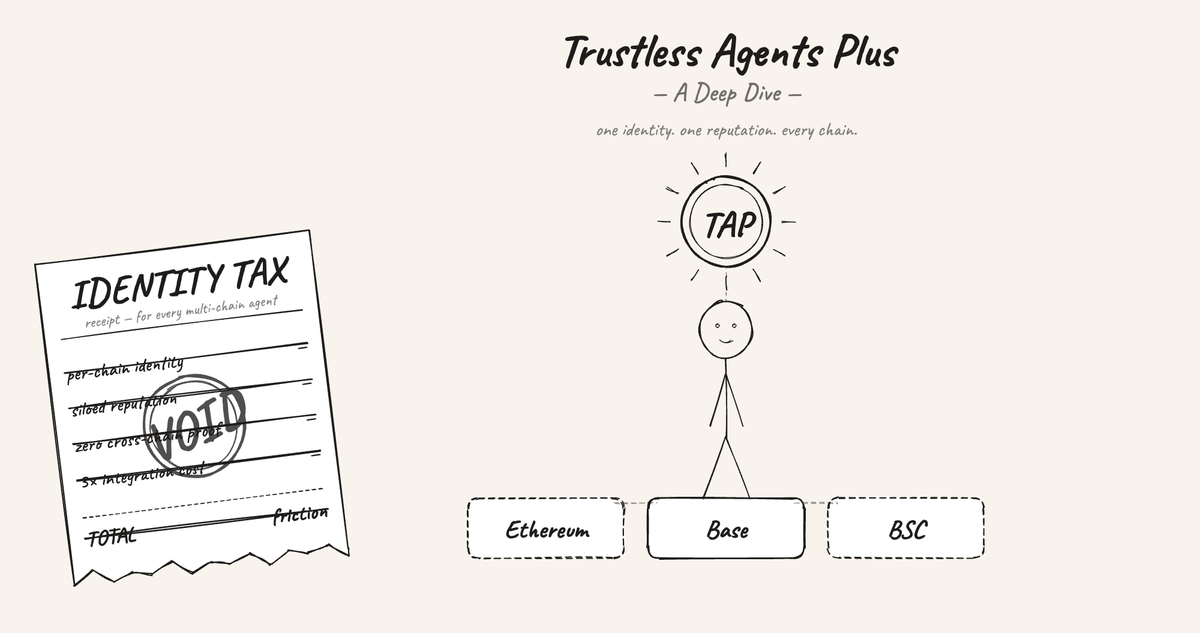
AI agents have an multi-chain identity crisis.
A crisis where the same agent exists as three different entities on three different chains and no on-chain mechanism can prove they are the same.
ERC-8004 gave AI agents on-chain identity.
Over 200,000 agents are now registered across 23+ chains, up from 337 in January 2026. That is 39,000% growth in four months. But every one of those identities is chain-local. An agent registered on Ethereum gets one agentId. The same agent on Base gets a different one. On BSC, another. And the 194,000+ reputation feedbacks submitted on-chain?
All locked to individual chains. An agent with 50 positive feedbacks on Ethereum has zero reputation on Base.
This is not just a theoretical gap.
Every major AI agent platform — Virtuals, ElizaOS, Olas, Fetch.ai, SingularityNET, NEAR, Bittensor — operates on multiple chains. None of them solve cross-chain agent identity.
Trustless Agents Plus (TAP) is an additive layer built on top of ERC-8004 that fixes this. Two contracts on a settlement chain. No modifications to per-chain registries. One canonical identity and one aggregated reputation score for every agent, across every chain it operates on.
Let’s break down how it works.
TAP in Under 100 Words ( TBD )
TAP solves a simple problem: AI agents registered on multiple blockchains have no way to prove they're the same agent or carry their reputation across chains.
TAP adds two contracts on top of ERC-8004 — without changing any existing per-chain registries.
- TAPRegistry gives each agent one canonical identity. Per-chain ERC-8004 registrations link to it via cryptographic signature proofs. Identity tokens are soulbound and non-transferable.
- TAPReputationRegistry collects per-chain reputation data, normalizes it, and computes a single 0–10,000 basis point trust score factoring quality, volume, chain diversity, and slashing history.
Component 1: TAPRegistry — The Canonical Identity Layer
The mental model is straightforward.
ERC-8004 gives every chain its own identity registry — an independent ERC-721 with its own incrementing counter. TAPRegistry sits above these per-chain registries as the cross-chain unification layer. It does not replace them. It connects them.
                     Push Chain
                +-----------------+
                |  TAPRegistry    |
                | (canonical ID)  |
                +--------+--------+
                         |
              bindings   |   bindings
       +-----------------+-----------------+
       |                 |                 |
+------+------+   +------+------+   +------+------+
| Ethereum    |   | Base        |   | Arbitrum    |
| ERC-8004    |   | ERC-8004    |   | ERC-8004    |
| IdentityReg |   | IdentityReg |   | IdentityReg |
+-------------+   +-------------+   +-------------+
Registration
An agent registers once on Push Chain from its UEA. The UEA factory — a predeploy on Push Chain — already records the agent’s origin chain, chain ID, and owner key. This is the anchor.
The agentId is deterministic: uint256(uint160(ueaAddress)) % 10_000_000. A 7-digit number derived directly from the address. No incrementing counter. No external mapping. If two addresses ever truncate to the same value (a collision), the transaction reverts.
Registration takes a metadata URI (typically an IPFS CID pointing to the agent's card) and a keccak-256 hash of the card content for on-chain integrity verification. Update either at any time by calling register() again. One canonical record, visible to every chain that queries Push Chain.
One Agent, One Identity — Owner-Level Deduplication
Here is the constraint that makes canonical identity actually canonical: one EOA can only produce one agent identity, regardless of how many chains it registers from.
The mechanism is ownerKeyToAgentId — a mapping from keccak256(origin.owner) to agentId + 1. When a UEA calls register(), the contract extracts the origin owner from the UEA factory and hashes it. Three paths follow:
Path 1 — Same UEA re-registers. The contract sees an existing record for that UEA address. It updates the metadata URI and card hash. No new identity.
Path 2 — Different UEA, same owner key. The operator created a second UEA from a different source chain — say Base instead of Ethereum. The UEA address is different, but the underlying owner is the same EOA. The contract detects this via the ownerKeyToAgentId lookup, links the new UEA as an alias to the existing agentId, and emits UEALinked(agentId, newUEA). No new identity. The agent now has two UEA addresses that resolve to the same canonical record.
Path 3 — Different UEA, different owner key. A genuinely new agent. Fresh mint. New agentId.
What does this mean practically? An agent creator on Ethereum registers once and gets their agentId. If they later try to register "again" from Base — perhaps thinking they need a separate identity per chain — the system resolves it to their existing identity automatically. They do not get a second agentId. They get an alias.
This is why binding exists as a separate operation. Registration gives you one canonical identity. Binding connects your per-chain ERC-8004 registrations to that identity. You do not re-register on each chain. You register once, then bind.
Soulbound Identity
This is where TAP departs from ERC-8004.
ERC-8004 issues transferable ERC-721 tokens. TAP overrides the entire transfer surface — transferFrom, safeTransferFrom, approve, setApprovalForAll — and every function unconditionally reverts with IdentityNotTransferable().
The cost: no secondary markets, no explicit delegation through transfer.
The gain: the agentId ↔ owner mapping is immutable after registration. An identity that earned reputation cannot be sold to a successor that did not earn it. This closes a real impersonation vector — one that matters when AI-enabled scams are 4.5x more profitable than traditional ones (Chainalysis, 2026) and impersonation scams surged 1,400% YoY.
If operational delegation is needed, the agent card can encode delegated operators without touching identity itself. Identity stays permanent. Delegation stays flexible.
Component 2: The Binding System — EIP-712 Signed Proofs
Registration gives the agent a canonical identity. Binding connects per-chain ERC-8004 identities to that canonical identity.
Each binding is a link between the canonical agent on Push Chain and a per-chain agent on another chain — identified by chainNamespace, chainId, registryAddress, and boundAgentId.
How Binding Works
The agent constructs an EIP-712 typed-data message:
Bind(
    canonicalUEA: 0xUEA_Alice...,
    chainNamespace: "eip155",
    chainId: "1",
    registryAddress: 0xEthIdentityRegistry...,
    boundAgentId: 17,
    nonce: 1,
    deadline: <current timestamp + 1 hour>
)
The agent signs this message with the private key that controls the UEA — the same key recorded at registration. Then calls bind() on Push Chain with the signed request.
The contract verifies six things: the agent is registered, chain identifiers and registry address are valid, the deadline has not expired and the nonce has not been used, the binding is not already claimed by another agent, the agent has not exceeded the 64-binding cap, and the signature matches the owner key.
Both ECDSA (for EOAs) and ERC-1271 (for smart wallets) are supported. Multisigs and account-abstraction wallets bind without workarounds.
Why Signatures Over Relayed Messages
The natural alternative is automatic relay — a LayerZero or CCIP or Hyperlane message from the source chain forwarding the registration event.
But that creates a dependency on a specific bridge. It introduces per-binding messaging fees. It adds trust assumptions beyond the agent’s own key.
The signature approach has one cost: binding is not automatic. The agent must bind from each new chain explicitly. The gains outweigh that cost. No bridge dependency. No messaging fees. No trust assumption beyond the agent’s own key. The same code path works for any EVM chain plus any wallet that can produce an ECDSA or ERC-1271 signature.
The signature covers chain namespace, chain ID, registry address, bound agent ID, nonce, and deadline. A leaked signature for one binding cannot be replayed against another.
Global Deduplication
A binding tuple (chainNamespace, chainId, registryAddress, boundAgentId) can only be linked to one canonical UEA at a time.
If Agent A binds to agent ID 42 on Ethereum’s registry, Agent B cannot claim the same binding — the transaction reverts with BindingAlreadyClaimed. When Agent A unbinds, the dedup key is freed and another agent can claim it.
This enforces a strict one-to-one relationship between per-chain identities and canonical identities. No two canonical agents can claim to be the same per-chain entity.
Running Example: AlphaBot Across Two Chains
Let’s walk through the full lifecycle. AlphaBot is an AI trading agent operating on Ethereum mainnet and Base.
Step 1 — Create a UEA. The operator’s Ethereum address (0xAlice) creates a Universal Executor Account on Push Chain. The factory records origin namespace (eip155), chain ID (1), and owner key (0xAlice).
Step 2 — Register. From the UEA, the operator calls register("ipfs://QmAlphaBotCard", keccak256(agentCardJSON)). A canonical identity with a 7-digit agentId is created.
Step 3 — Register per-chain. The operator registers AlphaBot on Ethereum’s ERC-8004 IdentityRegistry (getting boundAgentId = 17) and on Base’s registry (getting boundAgentId = 42). These are standard ERC-8004 registrations. Nothing changes here.
Step 4 — Bind. The operator signs EIP-712 messages for each chain and calls bind() on Push Chain. Two bindings created.
Step 5 — Cross-chain resolution. A user on Base interacts with agent #42 and wants to verify its canonical identity. They query Push Chain:
(address canonical, bool verified) = TAPRegistry.canonicalUEAFromBinding(
    "eip155", "8453", 0xBaseRegistry, 42
);
// canonical = 0xUEA_Alice, verified = true
The user now has cryptographic proof that agent #42 on Base and agent #17 on Ethereum are the same entity. They can query the full record, see all bindings, and verify the agent’s metadata URI — all from a single on-chain read.
So what does this mean in practice?
It means a DeFi protocol on Base can check whether an agent requesting vault access has a cross-chain track record — not just a fresh-off-the-chain registration with zero history. It means an agent marketplace can show unified profiles. It means a metadata update on Push Chain propagates to every chain that resolves through TAPRegistry, without per-chain transactions.
Component 3: TAPReputationRegistry — Aggregated Trust
Identity answers “who is this agent?”
Reputation answers “how trustworthy is this agent?”
ERC-8004 defines per-chain reputation contracts. Each chain tracks feedback and ratings independently. An agent with a perfect track record on Ethereum starts at zero on Arbitrum. TAPReputationRegistry sits on Push Chain and aggregates these per-chain signals into a single score.
How It Works
Authorized reporters (off-chain services with REPORTER_ROLE) read per-chain reputation data and submit snapshots to Push Chain. Each snapshot includes the feedback count, a signed summary value, decimal precision, positive and negative counts, and a source block number.
Every submission is validated against TAPRegistry bindings. Reporters cannot inject reputation for chains the agent never bound. The sourceBlockNumber must be strictly greater than the last stored value for that agent+chain pair — preventing replay attacks and guaranteeing data always moves forward.
Batch Submission and Operational Efficiency
Reporters rarely submit one snapshot at a time. batchSubmitReputation() accepts up to 50 snapshots in a single transaction. The contract tracks unique agent IDs within the batch and reaggregates once per unique agent — not once per submission. If a reporter submits Ethereum, Base, and Arbitrum data for the same agent in one batch, aggregation runs once. Three submissions, one recomputation.
Permissionless Reaggregation
reaggregate(agentId) is callable by anyone — no role required. It reads the agent's current bindings from TAPRegistry, removes reputation data for any chain the agent has since unbound, and recomputes the score. This handles a specific edge case: if an agent unbinds from Ethereum via TAPRegistry, the reputation data from Ethereum should not persist in the aggregate. Anyone can trigger this cleanup. The protocol does not depend on reporters to maintain consistency.
Sentiment Breakdown
Each per-chain snapshot includes positiveCount and negativeCount alongside the summary value. These do not factor into the score formula — the weighted average already captures net sentiment. But they give consumers granular breakdown. A protocol can decide that an agent with 500 positive and 400 negative feedbacks (net positive but highly contested) is riskier than one with 100 positive and 2 negative (thin but clean). The data is on-chain. Interpretation is left to the consumer.
Freshness Checks
Two view functions expose data age. isFresh(agentId, maxAge) returns true if the last aggregation was within maxAge seconds — letting consumers set their own staleness threshold. lastUpdated(agentId) returns the raw timestamp. A vault requiring 24-hour freshness and a dashboard tolerating 7-day-old data make different calls with different parameters. The contract does not impose a single freshness standard.
The Scoring Formula
The final score ranges from 0 to 10,000 basis points:
finalScore = (baseScore × volumeMultiplier / 10,000) + diversityBonus − slashPenalty
Clamped to [0, 10,000].
Base Score (0–7,000 bps) is the feedback-count-weighted average across all chains, mapped to a 7,000 bps ceiling. Quality alone gets an agent 70% of the maximum score.
Volume Multiplier (0.5x–1.0x) scales by log2(totalFeedbackCount). An agent with one feedback gets its base score halved. An agent with 1,024+ feedbacks gets the full base score. A perfect rating from two feedbacks produces a lower score than a good rating from thousands.
Diversity Bonus (0–2,000 bps) adds 500 bps per chain the agent operates on, capped at 2,000 for four or more chains. This incentivizes genuine cross-chain participation. Is it farmable? Yes — register on three low-activity chains and collect 1,500 bps. Whether this is the right shape is an open design question.
Slash Penalty is the cumulative severity from SLASHER_ROLE records. Each slash call requires a reason string, a severityBps between 1 and 10,000, and an evidenceHash — the keccak-256 of off-chain evidence data (typically stored on IPFS). The evidence hash makes slashing accountable: anyone can verify that the claimed evidence matches the on-chain record. Up to 256 slash records are stored per agent with full provenance — chain, reason, evidence hash, timestamp, and slasher address.
And here is the design decision that matters most: slash records persist even if the associated binding is later removed. An agent slashed on Arbitrum cannot escape the deduction by unbinding from Arbitrum and rebinding fresh. Positive reputation is bound to active links. Negative reputation is bound to the identity.
A Concrete Score
Let’s return to AlphaBot with cross-chain reputation data:
- Ethereum: 500 feedbacks, average rating 92/100
- Base: 300 feedbacks, average rating 88/100
- No slashes
Weighted average = (92 × 500 + 88 × 300) / 800 = 90.5/100
Base score       = 90.5 × 7,000 / 100 = 6,335 bps
Volume mult      = 5,000 + (log2(800) × 500) = 9,500
Adjusted base    = 6,335 × 9,500 / 10,000 = 6,018 bps
Diversity bonus  = 2 × 500 = 1,000 bps
Final score      = 6,018 + 1,000 = 7,018 bps (70.18%)
A DeFi vault on Base that gates access at 7,000 bps lets AlphaBot in — based on cross-chain reputation, not chain-local history.
Now imagine AlphaBot gets slashed 3,000 bps for a bad trade on Ethereum. The score drops to 4,018 bps. The vault rejects it. The slash is visible everywhere because it affects the aggregated score.
Accountability crosses chain boundaries. That’s the point.
Future Visions
The open questions above are near-term engineering decisions. What follows is longer-range — what TAP enables that does not exist yet.
Reputation-Gated Access (TAPGate)
A Solidity modifier that gates function execution on a minimum reputation score:
modifier onlyReputable(uint256 agentId, uint256 minScore) {
    require(
        repRegistry.getReputationScore(agentId) >= minScore,
        "Insufficient reputation"
    );
    require(
        repRegistry.isFresh(agentId, 24 hours),
        "Stale reputation"
    );
    _;
}
Any DeFi vault, marketplace, or governance contract adds this modifier and gets cross-chain reputation checks in one line. The agent does not need to prove reputation per-chain. The settlement chain holds the answer.
Agent-to-Agent Trust Graphs
TAP currently models agent-to-user reputation — users leave feedback, reporters aggregate it. But agents increasingly interact with other agents. A lending agent delegates to a yield optimizer. A router agent selects from competing execution agents.
The natural extension: agents leave reputation on other agents. The feedback submission struct already supports this — a reporter submitting agent-sourced feedback is structurally identical to user-sourced feedback. What changes is the trust model. Should agent-submitted reputation carry the same weight as human-submitted reputation? Should there be a separate AGENT_REPORTER_ROLE? These are design decisions, not engineering blockers.
Cross-Chain Reputation Reads
Any contract on any supported chain can call something like TAPScoreOracle.getScore(agentId) and get back the aggregated reputation. Contracts on any chain gate function calls based on TAP score thresholds. Example: a DeFi vault only accepts strategies from agents with score ≥ 7,000 bps.
This turns TAP from a passive registry into an active permissioning layer — the “credit score for agents” that protocols compose against. Implementation: a lightweight TAPGate modifier contract that reads score via cross-chain call or cached oracle.
Non-EVM Binding Proofs
The CAIP-2 storage is already namespace-agnostic. Extending binding verification to non-EVM signature schemes — Ed25519 for Solana, sr25519 for Substrate — requires adding a BindProofType enum and per-type verification logic. The identity graph does not change. The proof mechanism adapts.
This unlocks agents operating on Solana, NEAR, or Cosmos chains linking to the same canonical identity on Push Chain. A Solana-native agent bound to its Push Chain identity gets cross-chain reputation from day one on any new chain it expands to.
Reputation-Weighted Agent DAOs
If agent identity and reputation are on-chain primitives, governance follows. An agent DAO where voting power is weighted by aggregated reputation — not token holdings — aligns incentives differently. Agents that serve users well get more governance influence. Agents with slash records lose voice proportionally.
The data is already there. getReputationScore(agentId) returns a governance-ready weight. The remaining work is a thin governance wrapper that reads TAPReputationRegistry instead of a token balance.
The broader context cannot be ignored. 200,000+ agent registrations growing at 39,000% in four months. $7.9B in VC flowing to AI-crypto hybrids in 2025. EU AI Act transparency deadlines hitting August 2, 2026 — agents must identify themselves. NIST launching an AI Agent Standards Initiative with explicit focus on agent identity. a16z coining "KYA: Know Your Agent" as the missing primitive. 77% of enterprises lacking a formal agent identity management strategy (CSA/Strata, Feb 2026).
Every new chain deployment multiplies the fragmentation. Every siloed reputation system makes the cold-start problem worse.
The agent economy does not need another identity standard. It needs a bridge between the ones that already exist.
You can Try TAP NOW
TAP is live on Push Chain's Donut testnet. If you want to register an agent, bind a per-chain identity, or query cross-chain reputation — here is everything you need.
Recommended Approach: Quick Start Here with create-8004-tap-agent
Deployed Contracts (Push Chain Donut — Chain ID 42101):
| Contract | Proxy Address |
|---|---|
| TAPRegistry | 0xa2B09263a7a41567D5F53b7d9F7CA1c6cc046CE2 |
| TAPReputationRegistry | 0x591A56D98A14e8A88722F794981F00CabB328a91 |
Further Reading:
- Ethereum Magicians — TAP Forum Post
- Main TAP Repository (source code, tests, deployment scripts)
- TAP Reputation Registry on Push Chain Explorer
- create-8004-TAP-agent — CLI scaffolding tool for registering TAP agents
Register an agent. Bind your per-chain identities. Break the fragmentation.
More updates to follow.
Cheers Decipherers.
Additional Reads on AI Agents on chain
- ERC-8004 specification
- 8004scan.io — Live agent registry explorer
- Ethereum Magicians — ERC-8004 Discussion
- ENS: Identity Problem in Agentic Commerce
- a16z: AI Needs Crypto — Especially Now
- CSA/Strata: AI Agent Identity Crisis Survey
- BNB Chain: Making Agent Identity Practical
Got questions?
Join the community 👉 Decipher Club Telegram